Self hosted Bitwarden-Lite
A guide to Self hosted Bitwarden-Lite on arm64v8 vps with postgre 18.
PLEASE check this repo GitHub - GreenH47/bitwarden-n8n-backup for more details
How to Install Bitwarden Lite on Your Synology NAS – Marius Hosting
Lightweight and flexible: Bitwarden lite self-host deployment is now generally available | Bitwarden
Recommended architecture (secure-by-default)
-
Public Internet → Reverse proxy (TLS) → Bitwarden Lite container
-
PostgreSQL container on a private Docker network only (no public port)PostgreSQL
-
Backups:
- pg_dump (database) + backup of
/etc/bitwardenvolume (config/data) - Store offsite to S3
- pg_dump (database) + backup of
OS + network hardening baseline (VPS)
sudo apt update
sudo apt upgrade

# If you want Ubuntu to also handle dependency changes (install/remove packages as required),

sudo apt full-upgrade

sudo do-release-upgrade

sudo apt autoremove --purge

# optional
sudo apt-get install --install-recommends linux-generic-hwe-24.04

sudo reboot
setup bitwarden server
files tree
ubuntu@mainserver:~/bitwarden$ tree
.
├── backups
│   └──
├── bw-backup.sh
├── bw_data
│   ├── bitwarden
│   │   └──
│   ├── logs
│   │   └──
│   └── pg
│       └──
├── db.env
├── delete-old-files.sh
├── docker-compose.yml
└── settings.env
yaml
---

services:
  bitwarden:
    depends_on:
      - db
    env_file:
      - settings.env
    image: ghcr.io/bitwarden/lite:2026.1.0
    restart: always
    ports:
      - "127.0.0.1:7500:8080"
    volumes:
      - /home/ubuntu/bitwarden/bw_data/bitwarden:/etc/bitwarden
      - /home/ubuntu/bitwarden/bw_data/logs:/var/log/bitwarden

  # PostgreSQL Example
  db:
    env_file:
      - db.env
    image: postgres:18.1
    restart: always
    volumes:
      - /home/ubuntu/bitwarden/bw_data/pg:/var/lib/postgresql
environment files
# db.env
# database
POSTGRES_DB=    <replace it>
POSTGRES_USER=    <replace it>
POSTGRES_PASSWORD=    <replace it>

# Hardening: create cluster with SCRAM auth (applies on first init only)
POSTGRES_INITDB_ARGS=--auth-host=scram-sha-256 --auth-local=scram-sha-256
# settings.env
# bitwarden
BW_DOMAIN= <replace it>
BW_INSTALLATION_ID= <replace it>
BW_INSTALLATION_KEY= <replace it>
BW_DB_PROVIDER=postgresql
BW_DB_SERVER=db
BW_DB_DATABASE= <replace it>
BW_DB_USERNAME= <replace it>
BW_DB_PASSWORD= <replace it>
# After you’ve created your users, lock registration:
globalSettings__disableUserRegistration=truesetup permission
sudo chown -R 1000:1000 /home/ubuntu/bitwarden/bw_data/bitwarden /home/ubuntu/bitwarden/bw_data/logs
sudo chmod -R u+rwX,go-rwx /home/ubuntu/bitwarden/bw_data/bitwarden /home/ubuntu/bitwarden/bw_data/logs

sudo chown -R 999:999 /home/ubuntu/bitwarden/bw_data/pg
sudo chmod -R u+rwX,go-rwx /home/ubuntu/bitwarden/bw_data/pg
apply and run it
docker compose pull
docker compose up -d
setup reverse proxy
locate in /etc/nginx/sites-enabled/<yourdomain>.conf
# /etc/nginx/sites-enabled/<yourdomain>.conf
server {
    listen 80;
    listen [::]:80;
    server_name <yourdomain>;

    return 302 https://$server_name$request_uri;
}

server {

    # SSL configuration

    listen 443 ssl http2;
    listen [::]:443 ssl http2;
    ssl_certificate         /home/ubuntu/ssl/cert.pem;
    ssl_certificate_key     /home/ubuntu/ssl/key.pem;

    server_name <yourdomain>;

    # prevent search indexing
    add_header X-Robots-Tag "noindex, nofollow, noarchive, nosnippet, noimageindex" always;

    # block bots explicitly
    location = /robots.txt {
        return 200 "User-agent: *\nDisallow: /\n";
        add_header Content-Type text/plain;
    }


	location / {
        proxy_pass http://localhost:7500;
        proxy_set_header Host $host;
        proxy_set_header X-Real-IP $remote_addr;
    }
}
check and apply it
sudo nginx -t && sudo systemctl reload nginxBitwarden Lite + Postgres 18 bind-mount + backups (host folders + ACL + n8n-friendly)
Assumptions
-
tack directory:
/home/ubuntu/bitwarden -
Host data dirs (bind mounts):
/home/ubuntu/bitwarden/bw_data/bitwarden→/etc/bitwarden/home/ubuntu/bitwarden/bw_data/logs→/var/log/bitwarden/home/ubuntu/bitwarden/bw_data/pg→/var/lib/postgresql(Postgres 18+)
-
Users:
ubuntu= UID 1001n8ncontainer runs as UID 1000
-
Postgres container user commonly uses UID/GID 999 (so the host
pgdirectory must be writable by 999:999).
One-time setup
Install ACL tools
sudo apt-get update
sudo apt-get install -y acl
Create directories
mkdir -p /home/ubuntu/bitwarden/bw_data/bitwarden \
         /home/ubuntu/bitwarden/bw_data/logs \
         /home/ubuntu/bitwarden/bw_data/pg \
         /home/ubuntu/bitwarden/backups
Ownership + base permissions
# Bitwarden persisted state + logs owned by ubuntu
sudo chown -R ubuntu:ubuntu \
  /home/ubuntu/bitwarden/bw_data/bitwarden \
  /home/ubuntu/bitwarden/bw_data/logs \
  /home/ubuntu/bitwarden/backups

# Postgres data owned by container UID/GID (commonly 999:999)
sudo chown -R 999:999 /home/ubuntu/bitwarden/bw_data/pg

# Base perms (ACL will grant extra access)
sudo chmod 750 /home/ubuntu/bitwarden/bw_data/bitwarden \
               /home/ubuntu/bitwarden/bw_data/logs \
               /home/ubuntu/bitwarden/backups

sudo chmod 700 /home/ubuntu/bitwarden/bw_data/pg

# Allow running docker/compose without sudo (for ubuntu) log out/in to apply group change
sudo usermod -aG docker ubuntu
ACLs so uid 1000 + 1001 can access Bitwarden state/logs (and inherit)
# Existing files/dirs: allow both uid 1000 and 1001 read/write (plus traverse on dirs)
sudo setfacl -R -m u:1000:rwX,u:1001:rwX \
  /home/ubuntu/bitwarden/bw_data/bitwarden \
  /home/ubuntu/bitwarden/bw_data/logs

# Default ACL (inherit for new files/dirs created under these folders)
sudo setfacl -R -d -m u:1000:rwX,u:1001:rwX \
  /home/ubuntu/bitwarden/bw_data/bitwarden \
  /home/ubuntu/bitwarden/bw_data/logs

# ACLs for backups folder
sudo setfacl -m u:1000:rwx,u:1001:rwx /home/ubuntu/bitwarden/backups
sudo setfacl -d -m u:1000:rwx,u:1001:rwx /home/ubuntu/bitwarden/backups
Script permissions
chmod +x /home/ubuntu/bitwarden/bw-backup.py
chmod +x /home/ubuntu/bitwarden/delete-old-files.py

# Allow both uid 1000 and 1001 to execute the scripts
sudo setfacl -m u:1000:rwx,u:1001:rwx /home/ubuntu/bitwarden/bw-backup.py

sudo setfacl -m u:1000:rwx,u:1001:rwx /home/ubuntu/bitwarden/delete-old-files.py
backup flows
backup for database and bitwarden data
how to use
python3 /home/ubuntu/bitwarden/bw-backup.py 20260124T020000Z#!/usr/bin/env python3
"""
/home/ubuntu/bitwarden/bw-backup.py
Usage:
python3 /home/ubuntu/bitwarden/bw-backup.py 20260124T020000Z
Output (stdout):
{"status":"success","message":"..."} OR {"status":"failure","message":"..."}
"""
from __future__ import annotations
import gzip
import hashlib
import json
import os
import re
import shutil
import subprocess
import sys
import tarfile
from datetime import datetime, timezone
from pathlib import Path
# =========================
# CONFIG (edit these paths)
# =========================
STACK_DIR = Path("/home/ubuntu/bitwarden") # docker compose project directory
BACKUP_BASE = STACK_DIR / "backups" # must exist
BW_ETC_HOST = STACK_DIR / "bw_data" / "bitwarden" # persisted BW state (bind mount)
DB_SERVICE = "db" # docker compose service name for postgres
COMPOSE_CMD = ["docker", "compose"] # or ["docker","compose","-f","compose.yml"]
DATETIME_RE = re.compile(r"^\d{8}T\d{6}Z$") # e.g. 20260124T020000Z
def format_bytes(n: int) -> str:
units = ["B", "KB", "MB", "GB", "TB"]
size = float(n)
for u in units:
if size < 1024.0 or u == units[-1]:
return f"{size:.1f} {u}" if u != "B" else f"{int(size)} {u}"
size /= 1024.0
return f"{n} B"
def sha256_file(p: Path) -> str:
h = hashlib.sha256()
with p.open("rb") as f:
for chunk in iter(lambda: f.read(1024 * 1024), b""):
h.update(chunk)
return h.hexdigest()
def fail(msg: str, cleanup_paths: list[Path] | None = None, exit_code: int = 1) -> None:
# Best-effort cleanup (no extra stdout)
if cleanup_paths:
for p in cleanup_paths:
try:
if p.is_dir():
shutil.rmtree(p)
elif p.exists():
p.unlink()
except Exception:
pass
print(json.dumps({"status": "failure", "message": msg}, ensure_ascii=False))
raise SystemExit(exit_code)
def run_capture(cmd: list[str], cwd: Path, desc: str, timeout: int = 60) -> str:
try:
r = subprocess.run(
cmd,
cwd=str(cwd),
capture_output=True,
text=True,
timeout=timeout,
check=False,
)
except FileNotFoundError:
fail(f"{desc}: command not found: {cmd[0]}")
except subprocess.TimeoutExpired:
fail(f"{desc}: timed out running: {' '.join(cmd)}")
if r.returncode != 0:
err = (r.stderr or r.stdout or "").strip()
fail(f"{desc}: failed (exit {r.returncode}). {err[:4000]}")
return (r.stdout or "").strip()
def tar_dir_contents(src_dir: Path, out_tgz: Path) -> None:
# Equivalent to: tar -C "${src_dir}" -czf "${out_tgz}" .
with tarfile.open(out_tgz, mode="w:gz") as tf:
for root, dirs, files in os.walk(src_dir):
root_p = Path(root)
rel_root = root_p.relative_to(src_dir)
# Add directories (to preserve empty dirs)
for d in dirs:
d_path = root_p / d
arcname = (rel_root / d).as_posix()
ti = tf.gettarinfo(str(d_path), arcname=arcname)
tf.addfile(ti)
# Add files
for f in files:
f_path = root_p / f
arcname = (rel_root / f).as_posix()
tf.add(str(f_path), arcname=arcname, recursive=False)
def stream_pg_dump_to_gzip(sql_gz: Path, cwd: Path, db_service: str) -> None:
# Stream pg_dump output from container -> gzip file on host, without printing to stdout.
dump_cmd = COMPOSE_CMD + [
"exec", "-T", db_service, "sh", "-lc",
(
'set -e; '
'export PGPASSWORD="${POSTGRES_PASSWORD:-}"; '
'pg_dump -U "${POSTGRES_USER}" -d "${POSTGRES_DB}" '
'--no-owner --no-privileges --format=plain'
),
]
try:
p = subprocess.Popen(
dump_cmd,
cwd=str(cwd),
stdout=subprocess.PIPE,
stderr=subprocess.PIPE,
)
except FileNotFoundError:
fail("Postgres dump: docker command not found. Is Docker installed and in PATH?")
assert p.stdout is not None
assert p.stderr is not None
try:
with gzip.open(sql_gz, "wb", compresslevel=9) as gz:
for chunk in iter(lambda: p.stdout.read(1024 * 1024), b""):
gz.write(chunk)
rc = p.wait()
stderr = p.stderr.read().decode(errors="replace").strip()
if rc != 0:
fail(f"Postgres dump: pg_dump failed (exit {rc}). {stderr[:4000]}")
finally:
try:
p.kill()
except Exception:
pass
def main() -> None:
if len(sys.argv) != 2:
fail("Usage: bw-backup.py <datetime> (e.g. 20260124T020000Z)")
dt = sys.argv[1].strip()
# Validate DATETIME strictly
if not DATETIME_RE.fullmatch(dt):
fail("Invalid datetime format. Expected YYYYMMDDTHHMMSSZ (e.g. 20260124T020000Z).")
if "/" in dt or ".." in dt:
fail("Invalid datetime input: must not contain '/' or '..'.")
# Validate required paths
if not STACK_DIR.is_dir():
fail(f"STACK_DIR not found: {STACK_DIR}")
if not BACKUP_BASE.is_dir():
fail(f"BACKUP_BASE does not exist: {BACKUP_BASE} (create it first)")
if not BW_ETC_HOST.is_dir():
fail(f"Bitwarden data directory not found: {BW_ETC_HOST} (check bind mount path)")
out_dir = BACKUP_BASE / dt
bundle_tgz = BACKUP_BASE / f"{dt}.tar.gz"
bundle_sha = Path(str(bundle_tgz) + ".sha256")
# Replace existing output if rerun
cleanup_targets = [out_dir, bundle_tgz, bundle_sha]
if out_dir.exists():
shutil.rmtree(out_dir)
if bundle_tgz.exists():
bundle_tgz.unlink()
if bundle_sha.exists():
bundle_sha.unlink()
out_dir.mkdir(parents=True, exist_ok=True)
os.chmod(out_dir, 0o750)
# Basic docker sanity check
run_capture(COMPOSE_CMD + ["version"], cwd=STACK_DIR, desc="Docker Compose")
# Ensure db service is reachable and ready
run_capture(
COMPOSE_CMD + ["exec", "-T", DB_SERVICE, "sh", "-lc", "pg_isready -q"],
cwd=STACK_DIR,
desc=f"Database healthcheck (service '{DB_SERVICE}')",
timeout=30,
)
# Read DB/user from container env
db_name = run_capture(
COMPOSE_CMD + ["exec", "-T", DB_SERVICE, "sh", "-lc", 'printf "%s" "${POSTGRES_DB:-}"'],
cwd=STACK_DIR,
desc="Read POSTGRES_DB from container",
timeout=30,
)
db_user = run_capture(
COMPOSE_CMD + ["exec", "-T", DB_SERVICE, "sh", "-lc", 'printf "%s" "${POSTGRES_USER:-}"'],
cwd=STACK_DIR,
desc="Read POSTGRES_USER from container",
timeout=30,
)
if not db_name or not db_user:
fail("POSTGRES_DB / POSTGRES_USER not found in db container environment. Check db.env.", cleanup_paths=cleanup_targets)
# meta.txt
meta = out_dir / "meta.txt"
created_utc = datetime.now(timezone.utc).strftime("%Y-%m-%dT%H:%M:%SZ")
meta_contents = (
f"backup_datetime={dt}\n"
f"created_utc={created_utc}\n"
f"stack_dir={STACK_DIR}\n"
f"compose_project_dir={STACK_DIR}\n"
f"POSTGRES_DB={db_name}\n"
f"POSTGRES_USER={db_user}\n"
)
meta.write_text(meta_contents, encoding="utf-8")
os.chmod(meta, 0o640)
# 1) Postgres dump -> sql.gz
sql_gz = out_dir / f"bitwarden-{dt}.sql.gz"
stream_pg_dump_to_gzip(sql_gz, cwd=STACK_DIR, db_service=DB_SERVICE)
os.chmod(sql_gz, 0o640)
# 2) Archive BW persisted state -> tar.gz
etc_tgz = out_dir / f"etc-bitwarden-{dt}.tar.gz"
tar_dir_contents(BW_ETC_HOST, etc_tgz)
os.chmod(etc_tgz, 0o640)
# 3) Checksums for artifacts
sums_txt = out_dir / "sha256sums.txt"
sums_txt.write_text(
f"{sha256_file(sql_gz)} {sql_gz.name}\n"
f"{sha256_file(etc_tgz)} {etc_tgz.name}\n",
encoding="utf-8",
)
os.chmod(sums_txt, 0o640)
# 4) Bundle the whole folder into a single tar.gz
with tarfile.open(bundle_tgz, mode="w:gz") as tf:
tf.add(str(out_dir), arcname=dt)
os.chmod(bundle_tgz, 0o640)
bundle_hash = sha256_file(bundle_tgz)
bundle_sha.write_text(f"{bundle_hash} {bundle_tgz.name}\n", encoding="utf-8")
os.chmod(bundle_sha, 0o640)
# Delete the temp folder after bundling
shutil.rmtree(out_dir)
# Success JSON (only two keys)
size_bytes = bundle_tgz.stat().st_size
print(json.dumps({"status": "success", "message": f"Bundle size: {format_bytes(size_bytes)}"}, ensure_ascii=False))
if __name__ == "__main__":
try:
main()
except SystemExit:
raise
except Exception as e:
# Catch-all: human readable failure
print(json.dumps({"status": "failure", "message": f"Unexpected error: {e}"}, ensure_ascii=False))
raise SystemExit(1)delete files and folder older than 30 days
how to use
# test run
DAYS=30 DRY_RUN=1 python3 /home/ubuntu/bitwarden/delete-old-files.py 20270124T020000Z

# run it n8n workflow
python3 /home/ubuntu/bitwarden/delete-old-files.py 20260124T020000Z
#!/usr/bin/env python3
"""
/home/ubuntu/bitwarden/delete-old-files.py
Permanently delete anything in BACKUP_BASE older than (or equal to) N days
relative to the provided reference datetime (UTC).
Usage:
python3 /home/ubuntu/bitwarden/delete-old-files.py 20260124T020000Z
Environment overrides (optional):
DAYS=30 Number of days to keep (default from DEFAULT_DAYS_TO_KEEP)
DRY_RUN=1 Only print what would be deleted (default from DEFAULT_DRY_RUN)
Optional dry run:
DAYS=30 DRY_RUN=1 python3 /home/ubuntu/bitwarden/delete-old-files.py 20270124T020000Z
Output:
Prints ONE human-readable summary line to stdout (so n8n can use {{$json.stdout}} directly).
Exit code 0 = success, non-zero = failure.
"""
from __future__ import annotations
import os
import re
import shutil
import sys
from dataclasses import dataclass
from datetime import datetime, timedelta, timezone
from pathlib import Path
# =========================
# CONFIG (edit these)
# =========================
BACKUP_BASE = Path("/home/ubuntu/bitwarden/backups")
DEFAULT_DAYS_TO_KEEP = 30
DEFAULT_DRY_RUN = False
# =========================
DATETIME_RE = re.compile(r"^\d{8}T\d{6}Z$") # YYYYMMDDTHHMMSSZ
def fmt_bytes(n: int) -> str:
units = ["B", "KB", "MB", "GB", "TB"]
size = float(n)
for u in units:
if size < 1024.0 or u == units[-1]:
return f"{size:.1f} {u}" if u != "B" else f"{int(size)} {u}"
size /= 1024.0
return f"{n} B"
def parse_ref_datetime(dt_str: str) -> datetime:
# dt_str: YYYYMMDDTHHMMSSZ -> aware datetime UTC
# Example: 20260124T020000Z
year = int(dt_str[0:4])
month = int(dt_str[4:6])
day = int(dt_str[6:8])
hour = int(dt_str[9:11])
minute = int(dt_str[11:13])
second = int(dt_str[13:15])
return datetime(year, month, day, hour, minute, second, tzinfo=timezone.utc)
def get_env_int(name: str, default: int) -> int:
v = os.getenv(name)
if v is None or v == "":
return default
if not v.isdigit():
raise ValueError(f"{name} must be an integer (got '{v}')")
return int(v)
def get_env_bool(name: str, default: bool) -> bool:
v = os.getenv(name)
if v is None or v == "":
return default
return v.strip() in ("1", "true", "TRUE", "yes", "YES", "on", "ON")
def safe_top_level_children(base: Path) -> list[Path]:
# Equivalent to: find base -mindepth 1 -maxdepth 1
return [p for p in base.iterdir()]
def dir_size_bytes(p: Path) -> int:
# Best-effort size calculation for reporting only
if p.is_symlink():
return 0
if p.is_file():
try:
return p.stat().st_size
except Exception:
return 0
total = 0
if p.is_dir():
for root, _, files in os.walk(p):
for f in files:
fp = Path(root) / f
try:
if not fp.is_symlink():
total += fp.stat().st_size
except Exception:
pass
return total
@dataclass
class Result:
deleted: list[Path]
would_delete: list[Path]
reclaimed_bytes: int
cutoff_iso: str
ref_iso: str
def run(ref_dt: datetime, days_to_keep: int, dry_run: bool) -> Result:
if not BACKUP_BASE.is_dir():
raise FileNotFoundError(f"Backup base does not exist: {BACKUP_BASE}")
cutoff_dt = ref_dt - timedelta(days=days_to_keep)
# Match bash logic: delete items with mtime <= cutoff
cutoff_epoch = cutoff_dt.timestamp()
targets: list[Path] = []
for p in safe_top_level_children(BACKUP_BASE):
try:
st = p.lstat() # do not follow symlinks
except FileNotFoundError:
continue
if st.st_mtime <= cutoff_epoch:
targets.append(p)
reclaimed = 0
deleted: list[Path] = []
would_delete: list[Path] = []
for p in sorted(targets, key=lambda x: x.name):
# Safety: refuse anything outside BACKUP_BASE
try:
p.resolve().relative_to(BACKUP_BASE.resolve())
except Exception:
raise RuntimeError(f"Safety stop: refusing to delete outside {BACKUP_BASE}: {p}")
reclaimed += dir_size_bytes(p)
if dry_run:
would_delete.append(p)
continue
# Delete
try:
if p.is_symlink() or p.is_file():
p.unlink()
else:
shutil.rmtree(p)
deleted.append(p)
except Exception as e:
raise RuntimeError(f"Failed deleting '{p}': {e}")
return Result(
deleted=deleted,
would_delete=would_delete,
reclaimed_bytes=reclaimed,
cutoff_iso=cutoff_dt.strftime("%Y-%m-%dT%H:%M:%SZ"),
ref_iso=ref_dt.strftime("%Y-%m-%dT%H:%M:%SZ"),
)
def main() -> int:
if len(sys.argv) != 2:
print("FAILURE: Usage: delete-old-files.py <datetime like 20260124T020000Z>")
return 2
dt_str = sys.argv[1].strip()
if not DATETIME_RE.fullmatch(dt_str) or "/" in dt_str or ".." in dt_str:
print("FAILURE: datetime must match YYYYMMDDTHHMMSSZ (e.g. 20260124T020000Z)")
return 2
try:
days = get_env_int("DAYS", DEFAULT_DAYS_TO_KEEP)
dry_run = get_env_bool("DRY_RUN", DEFAULT_DRY_RUN)
ref_dt = parse_ref_datetime(dt_str)
except Exception as e:
print(f"FAILURE: {e}")
return 2
try:
r = run(ref_dt=ref_dt, days_to_keep=days, dry_run=dry_run)
except Exception as e:
print(f"FAILURE: {e}")
return 1
if dry_run:
if not r.would_delete:
print(
f"SUCCESS (DRY_RUN): Nothing to delete in {BACKUP_BASE}. "
f"Keeping last {days} day(s); cutoff <= {r.cutoff_iso} (ref {r.ref_iso})."
)
return 0
items = ", ".join(p.name for p in r.would_delete)
print(
f"SUCCESS (DRY_RUN): Would delete {len(r.would_delete)} item(s) from {BACKUP_BASE} "
f"with mtime <= {r.cutoff_iso} (ref {r.ref_iso}). "
f"Estimated reclaim: {fmt_bytes(r.reclaimed_bytes)}. Targets: {items}"
)
return 0
if not r.deleted:
print(
f"SUCCESS: Nothing to delete in {BACKUP_BASE}. "
f"Keeping last {days} day(s); cutoff <= {r.cutoff_iso} (ref {r.ref_iso})."
)
return 0
items = ", ".join(p.name for p in r.deleted)
print(
f"SUCCESS: Deleted {len(r.deleted)} item(s) from {BACKUP_BASE} "
f"with mtime <= {r.cutoff_iso} (ref {r.ref_iso}). "
f"Reclaimed approx {fmt_bytes(r.reclaimed_bytes)}. Deleted: {items}"
)
return 0
if __name__ == "__main__":
raise SystemExit(main())N8N workflow
setup
- mount your backups into
/home/node/.n8n-files
services:
  n8n:
    volumes:
      - /home/ubuntu/n8n.webhook/data/n8n:/home/node/.n8n
- /home/ubuntu/bitwarden/backups:/home/node/.n8n-files/bitwarden-backups:ro- allow your custom mount path
# n8n.env
N8N_RESTRICT_FILE_ACCESS_TO=/home/node/.n8n-files;/data/bitwarden-backups- restart the node
docker compose down
docker compose up -d
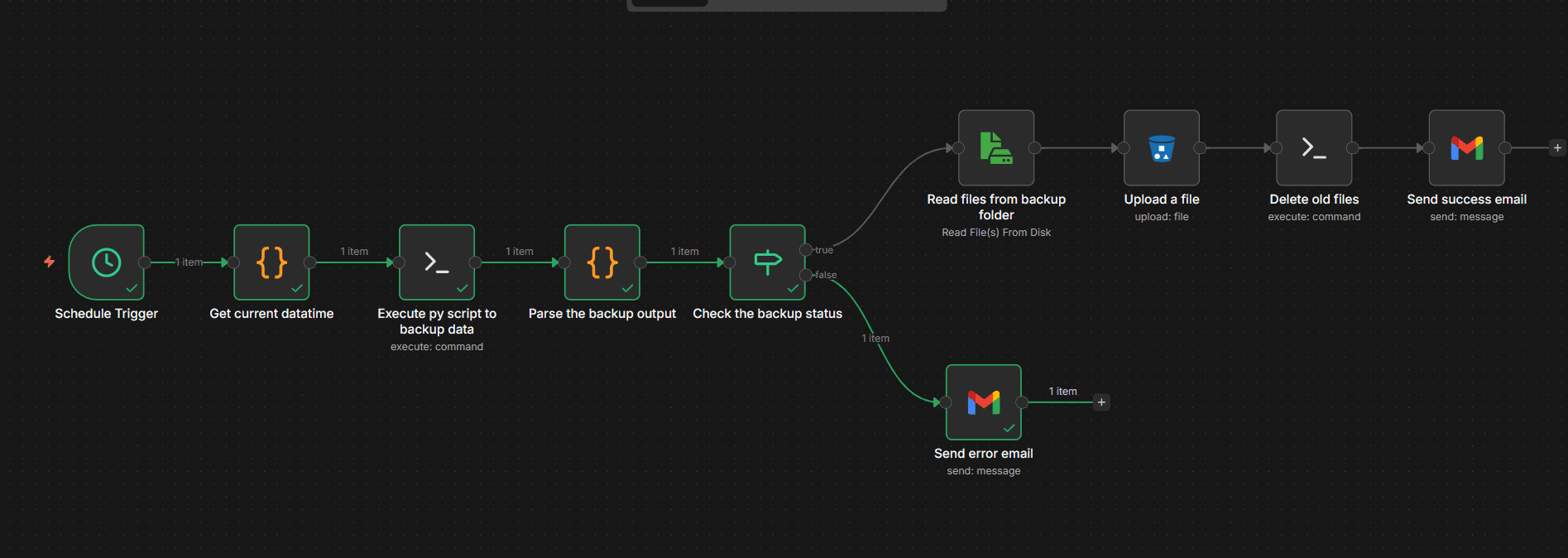
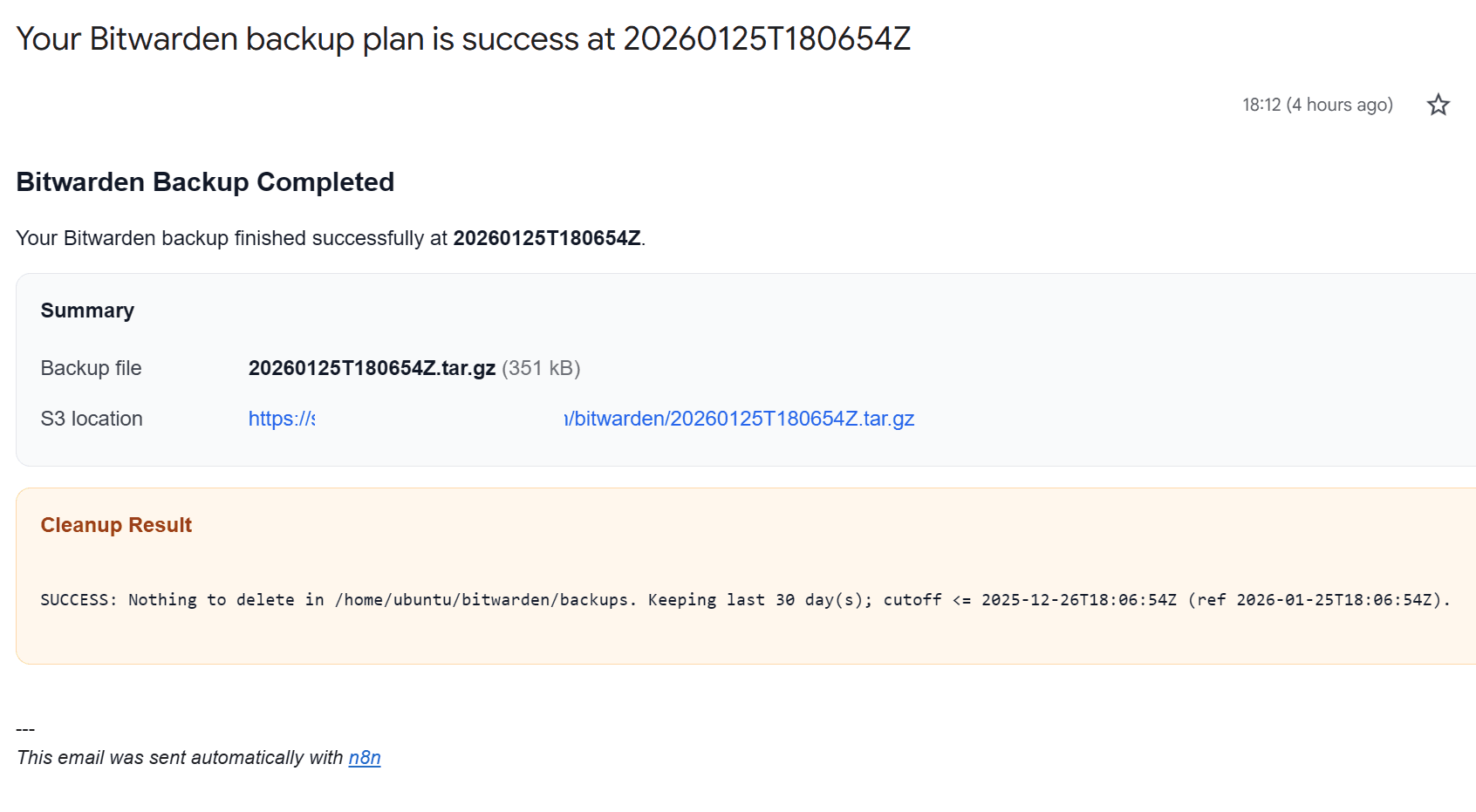
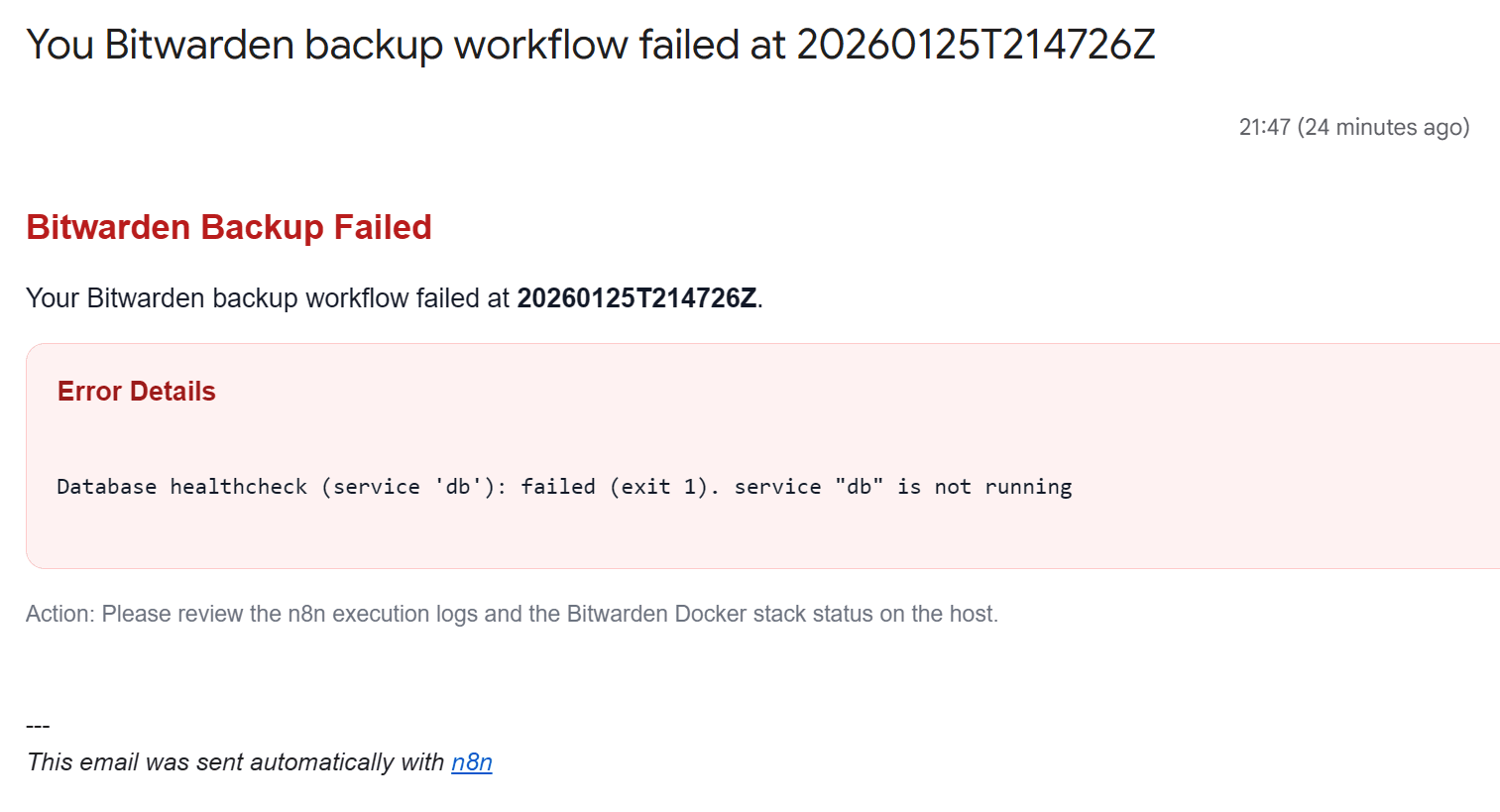
workflow and result
copy the workflow and change to your details
Exporting and importing workflows | n8n Docs